
Pure Music & the Andante of Shostakovich’s Second Piano Concerto (and a dubious discovery)
Through my years as a musician, I have devised a sort of guided inner compass to decide whether a piece of Music belongs to the highest tier of masterworks, or not (for me). It goes like this: can I easily find words to describe the piece in its entirety, or most of its inner passages/segments ? The words could describe anything. An emotion, a concept or thought, even a philosophical idea. If the answer is yes, then the maximum the compass will point towards will be ‘great Music’. But not ‘pure Music’, the highest tier; and where human language fails.
Some examples !
Brahms’ Third Symphony, slow movement: Clearly ‘bittersweet’; and it has the stench of unrequited love. Not that I don’t like it. I have probably listened to it and played that movement on the piano thousands of times when I was in my late twenties.
Think of the C major one of LvB’s Razumovsky Quartets, last movement. ‘Playful’, ‘Bold’, ‘Ludique’ (pardon my French)
Or… hum… the beginning of Ravel’s Daphnis et Chloé: ‘Sun rays splashing on a shallow lake surrounded by a multicolored meadow at dusk’
Schubert’s A Major Piano Sonata, slow movement: ‘Sorrowful’ ‘Longing’ ‘How a sad heart can still appreciate Autumn’
Let’s make it a bit simpler.
Beethoven’s 5th Symphony, first bars: ‘Angry’
Strauss’ Burleske: ‘Kitsch’
Mahler’s 5th Symphony, the Adagietto: ‘Love’
Rachmaninoff’s First Suite for two pianos: ‘Scorpio Love’
Paganini’s 24th Caprice: ‘mischievous’ ?
Bach’s Chaconne: ‘Pain, grief, absolution, suffering’ ?
Mahler’s 2nd Symphony, last bars: ?
Chopin’s 4th Ballade:
Beethoven’s op. 111:
Brahms’ Deutsches Requiem:
Shostakovich’s Second Piano Concerto’s Andante:
.
Point made.
This movement has been a dear companion to me since my early twenties. I remember listening to it in 2012, in a bus during a cold February night, coming back from a piano class concert. Those were the days where I still could fall in love, and I was madly in love; drowning and drowning in my longing. I clearly remember my feelings and thoughts during that trip. I was already sad about having lost the zest and wonder of my childhood. I remember thinking that if the ‘2012 end of the world prophecy’ was true, the feeling of cold air on my face was still beautiful. I remember thinking how deep and indescribable this Music was; so strange, so deep, so deep, like gravity in a black hole, pulling you in, in, and even further in, even after nothing remains. I remember how I thought this Music seemed to talk about how being alive is such a very serious endeavor, and the journey burdensome and heavy.
I think this is the kind of ‘pure Music’ where language is no more. Someone else may describe this movement in a completely different way and take a more positive tone as opposed to my gloom; one could say the piece describes how only through cracks can light enter. Or call it ‘warm’ or ‘pensive’. That’s the beauty of such masterpieces. Chopin’s E minor prelude, for another example, will be called ‘sad’ by 100 out of 100 of listeners. No one will disagree and no one will call it ‘happy’ or ‘joyful’. But a single bar of Chopin’s Fourth Ballade will create an endless kaleidoscope of words in the human language, ranging from pure ecstasy to the macabre. It’s a masterpiece.
This masterpiece though, the Andante, is a strange one. It certainly is the kind of piece where one can say ‘if the composer only wrote this his whole life, he would still be called a genius’, (like the Liszt Sonata). It is such a simple composition, it’s not complex at all; it uses very limited means which only adds to the immeasurable depth of what it conveys. I could never could figure out why Shostakovich would put a movement like this in a piece gifted (and dedicated) to his own son Maxim (also a musician). I tried to dig in and said it could be about the heavy responsibility of creating and putting a soul into a journey on this world, or about how he was trying to tell his 19 year old son that life not just roses, but thorns too, and about how he wished he could protect him from them forever.
Let’s move on to the dubious discovery. I think I may have cracked the key to this movement, a few days before I will conduct it for the first time, joined by the pianist Hande Dalkılıç in Datça, for the 7th İdil Biret Festival which I take great honor to be part of again.
Here’s my favorite recording. Give it a listen if you don’t know the piece: https://www.youtube.com/watch?v=06AXbrJTy5Y&list=RD06AXbrJTy5Y&start_radio=1
Now, look at the orchestration here, at the end of the movement:
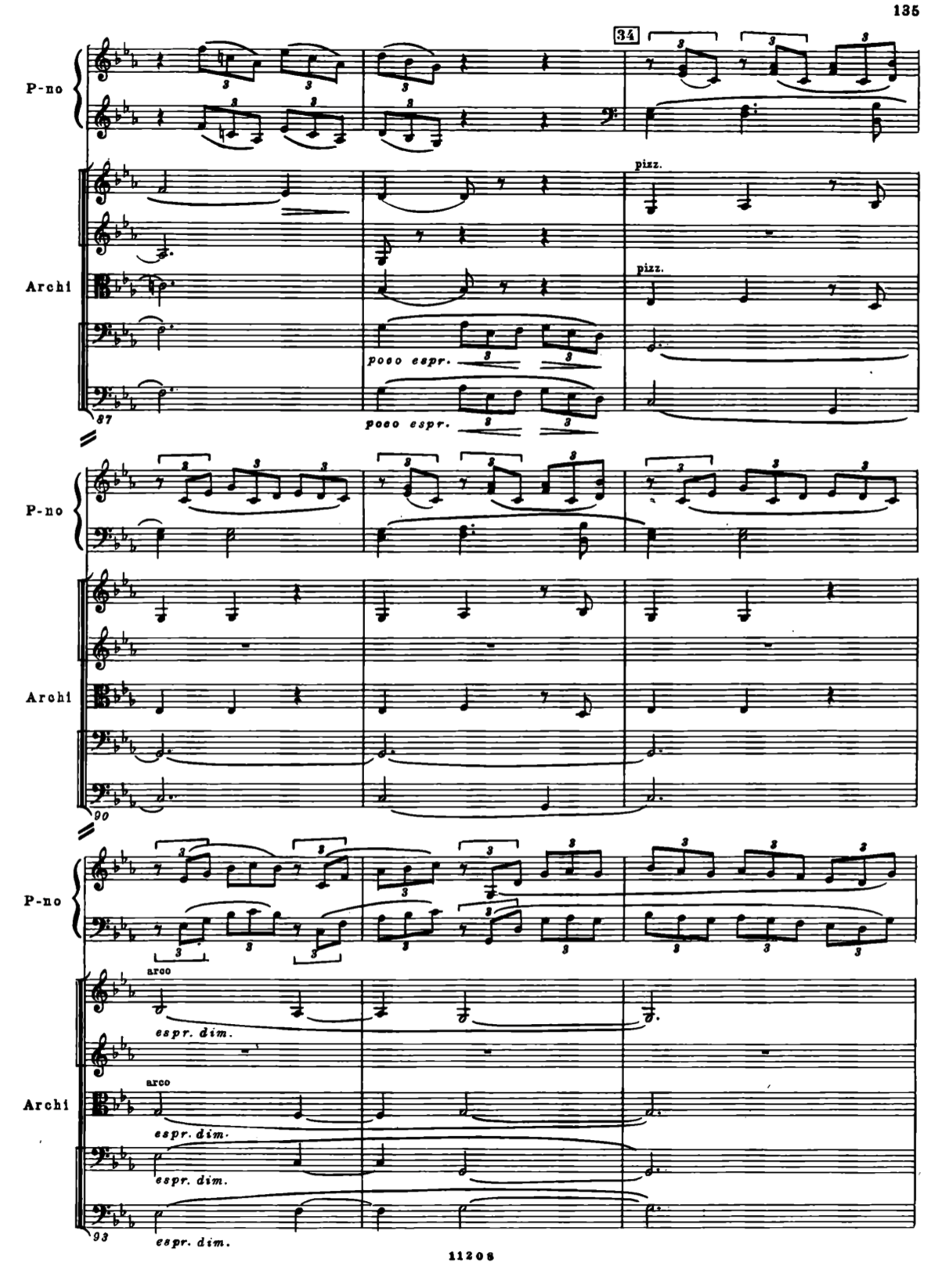
The second violin section, who has almost continuously played during the whole movement, suddenly stops playing until the end of the movement (we’re about 75 % through when they stop). After careful examination, I found it very odd. There is no apparent reason for this in the orchestration, the solo piano doesn’t change its register, there is no insistent pedal chord which the second violins would somehow emphasize too much or fight against, there is no change in nuance. There is a sort of gradual diminuendo al fine, but it’s only vaguely implied. Besides, the whole movement is mostly marked pianissimo, and all the strings are con sordino anyway. Leaving out the second violins would not have a substantial effect on the diminuendo al fine.
And look at how most of the movement goes, and how the second violins are used in contexts that are basically the same:
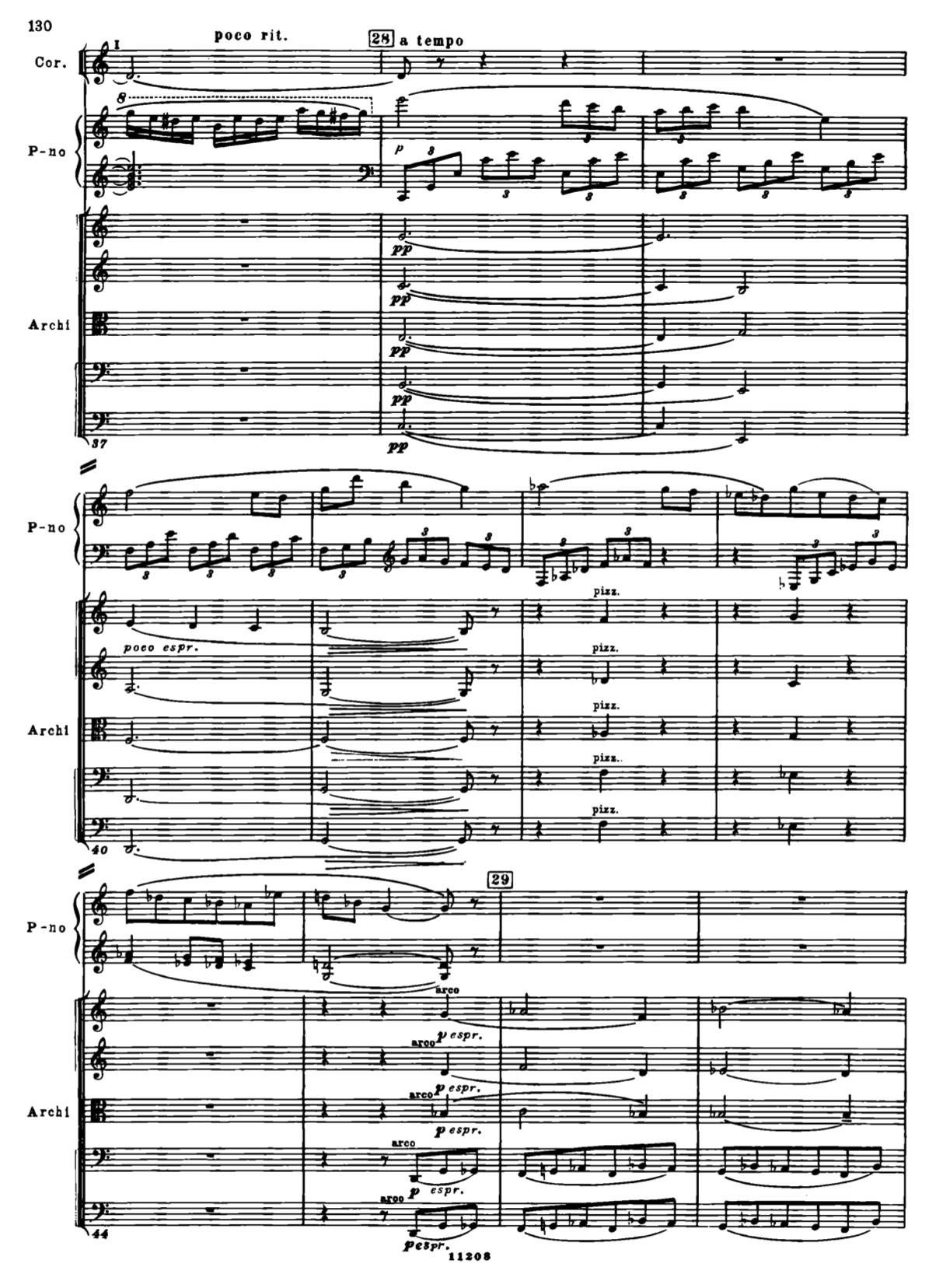
The achilles heel of my theory is that the first violins are already at the limit of their low register (look at the previous photo). But I still find this odd and deliberate. One could easily double the low C in the celli and contrabassi or even play that same C an octave below (which would make a nice culmination for the end of the movement), or double the third of the c minor chord instead of the fifth (which would make the chord sound even more ethereal but hey, I sure ain’t a Shostakovich grade composer)
Anyway. With my nose buried in the score last evening, I had a hunch, a sort of feeling in the back of my head and a voice that said: ‘when did his wife die ? (His son Maksim’s mother). I googled it and saw that she had suddenly died, which obviously had a devastating impact on the family. This event was two years before the son asked the father to write a concerto for him. I was quite shaken and felt my eyes watering up.
So. Somehow, I’m now convinced that the second violins abruptly stopping for MAYBE no reason represents his wife Nina’s death, and that the core, the key to this piece is actually grief. It seems I’m also under the egomaniacal impression that the composer’s spirit spoke to me with that cold chill I felt in the back of my head and pointed me in the right direction. But that might be me being mad as fuck as usual. I do believe in spirits and signs sent from Angels though, but hey that’s just me
This is being quite the revealing blogpost about who I really am beyond the cool little masks I use. Oh well. Had to start sometime. The point of this blog was always about coming back to the courage for self expression that I, once upon a time, had very much of. The musical searches and examinations are only secondary to this purpose and more of an amuse bouche for hungry minds. I always fantasize about sharing my personal diaries on here too, things about unmusical matters, but that’s for another time.
Let’s finish this by talking some more about pure Music. Unlike most of my blogposts, I’m not trying to make an argument here. I’m also quite aware that I have completely contradicted myself because I just gave the most explicit description ever to a work which I had categorized as a masterpiece, thus obliterating my initial idea that the purest music always makes language fail. (Oh boy is the mask back on ! Look at him trying to use all these big words to sound all smart, detached, and rational !!)
But I think that what I’ve been really trying to say, what’s been on the tip of my tongue, is actually simple and didn’t require channeling dead spirits or finding new ideas to make an argument more muscular.
Perhaps pure Music is not Music that cannot be described with words. Perhaps it is Music that cannot be contained by them.
We can throw words at a piece of Music. Grief. Love. Death. Childhood. Longing. God. Nina. A father looking at his son. We can even discover a biographical fact, stare at two suddenly silent violin desks and convince ourselves, rightly or wrongly, that for one fleeting second we have found a key.
But the door that opens is still infinitely larger than the key.
People have spent two centuries trying to attach stories to Chopin’s Ballades, including the poems of Adam Mickiewicz that may or may not hover somewhere behind their conception. Fine. Let’s read the poem and learn the story. But listen to the last pages of the 4th Ballade.
The words still fail. Not because they are wrong. That is the distinction I think I was missing at the beginning of this post. They may be completely right. The Fourth Ballade may contain grief, terror, tenderness, ecstasy, memory, touching divinity and then suddenly descending back into hell. This Andante may indeed contain the composer’s departed wife, Nina. Perhaps those absent second violins really are a dead wife leaving a father and his nineteen-year-old son behind. Perhaps they aren’t.
But even if tomorrow I found a letter from Dmitri Shostakovich saying, word for word, yes, Deniz, that is exactly what I meant,
That would still not explain the Andante of Shostakovich’s Second Piano Concerto.
Such is the mystery of Music…
